

When Should You Consult a Pain Management Doctor?
Acute pain is a protective biological warning sign that alerts your body to tissue injury. However, when pain persists beyond 3 months—or outlasts the normal expected healing time of an injury—it transitions into chronic pain. In chronic pain states, pain is no longer just a symptom; it becomes a complex neuro-musculoskeletal condition requiring specialized evaluation.
Many individuals in Kukatpally and Hyderabad attempt to self-manage persistent pain with frequent over-the-counter painkillers or prolonged bed rest. While analgesics may offer temporary comfort, relying on them without identifying the anatomical pain generator can lead to medication tolerance, gastrointestinal complications, and progressive joint or nerve deterioration.
Consider scheduling a specialist evaluation if you notice:
- Pain persisting continuously for more than 4 to 6 weeks despite rest and routine medications.
- Pain that repeatedly returns or flares up with normal daily movements, sitting, or walking.
- Radiating symptoms, such as burning, electric shocks, tingling, or numbness traveling down an arm or leg.
- Stiffness or aching that disrupts your sleep or prevents you from performing your work duties.
- Joint or spine discomfort where you have been advised to consider surgery, but wish to explore evidence-based non-surgical alternatives first.
When Does Pain Require Immediate Emergency Medical Attention?
While most chronic back, neck, and joint conditions can be safely evaluated on an outpatient basis, certain “red flag” symptoms indicate acute nerve compression, spinal cord compromise, or life-threatening systemic emergencies. Seek immediate emergency medical care if you experience:
- New bladder or bowel control problems: Sudden loss of control (incontinence) or inability to pass urine (acute urinary retention).
- Groin or saddle numbness: Loss of sensation in your genital area, inner thighs, or buttocks (saddle anesthesia, indicative of Cauda Equina Syndrome).
- Rapidly worsening weakness: Progressive motor loss in the legs or feet, such as foot drop, difficulty lifting your toes, or sudden leg buckling.
- Severe chest pain: Sharp crushing pain, tightness, or pain radiating to the jaw, neck, or left arm, accompanied by shortness of breath.
- Sudden serious symptoms: Severe unrelenting pain accompanied by high fever, chills, unexplained weight loss, or history of malignancy.
What Conditions Does a Pain Management Doctor Treat?
An interventional pain physician treats a comprehensive spectrum of acute, persistent, and chronic pain conditions affecting the spine, peripheral joints, muscles, and nerves. At Aarish Clinics, clinical assessments focus on distinguishing whether the primary generator is discogenic, facet-mediated, neural, or soft-tissue related:
1. Chronic Back Pain & Sciatica
Lower back discomfort is the most common reason patients seek pain specialist care. Conditions treated include lumbar disc herniations, disc bulges, lumbar canal stenosis, facet joint arthropathy, and sciatica (lumbar radiculopathy) causing shooting pain down the buttock, thigh, and calf.
2. Chronic Neck Pain & Cervical Spondylosis
Prolonged desk work and screen exposure commonly accelerate cervical degenerative changes. Pain specialists treat cervical disc prolapse, cervical radiculopathy (pinched nerve in the neck radiating pain, numbness, or weakness into the arm and hand), and cervicogenic headaches originating from upper neck facet irritation.
3. Knee Pain & Joint Osteoarthritis
Knee osteoarthritis causes gradual loss of cartilage cushioning, resulting in joint space narrowing, bone-on-bone friction, stiffness, and difficulty climbing stairs. Non-surgical pain care includes targeted joint preservation injections, sensory genicular nerve blocks, and regenerative therapies for mild to moderate degeneration.
4. Shoulder Pain, Frozen Shoulder & Tendinopathies
Shoulder mobility limitations frequently stem from adhesive capsulitis (frozen shoulder), rotator cuff tendinitis, subacromial bursitis, or acromioclavicular joint arthrosis. Specialist hydrodilatation, ultrasound-guided bursal injections, and suprascapular nerve blocks help restore motion and alleviate nighttime aching.
5. Nerve Pain, Neuropathy & Complex Neuralgias
Nerve-mediated pain feels fundamentally different from muscle strain, manifesting as sharp, burning, tingling, or electric sensations. Conditions evaluated include diabetic peripheral neuropathy, post-herpetic neuralgia following shingles, occipital neuralgia, and peripheral nerve entrapment syndromes.

What Treatments Are Available for Chronic Pain?
Modern pain medicine follows a tiered, stepwise ladder. In the vast majority of cases, pain can be effectively managed without open spinal or joint surgery through a tailored combination of conservative rehabilitation, pharmacological optimization, and precision image-guided interventions:
1. Conservative Management & Structured Rehabilitation
First-line care combines evidence-based physiotherapy, ergonomic posture training, core muscle stabilization, and carefully rationalized pharmacotherapy. Medication reviews focus on avoiding unnecessary reliance on opioids while using targeted neuropathic agents or anti-inflammatory medications where clinically appropriate.
2. Diagnostic & Therapeutic Nerve Blocks
A nerve block involves placing a precise dose of local anesthetic (with or without an anti-inflammatory medication) directly adjacent to the nerve transmitting pain signals. Examples include medial branch blocks for spine facet pain, genicular nerve blocks for chronic knee pain, and selective nerve root blocks. They serve dual purposes: confirming the exact anatomical pain generator (diagnostic) and breaking the acute pain loop (therapeutic).
3. Epidural Steroid Injections (ESI)
For patients suffering from sciatica or cervical radiculopathy caused by disc herniation or spinal stenosis, transforaminal epidural injections deliver targeted medication directly into the epidural space around the irritated nerve sleeve. Performed under real-time fluoroscopic or ultrasound visualization, this procedure calms intense localized inflammation and reduces nerve swelling.
4. Radiofrequency Ablation (RFA)
Radiofrequency ablation is an advanced interventional technique utilized when diagnostic nerve blocks confirm facet joint arthropathy or chronic knee pain. Using specialized radiofrequency needles, controlled thermal energy creates a targeted interruption along the sensory nerve fibers. This prevents pain signals from reaching the brain, offering durable relief typically lasting between 6 and 18 months while allowing normal motor function.
5. Platelet-Rich Plasma (PRP) & Regenerative Therapy
Regenerative medicine utilizes biological growth factors concentrated from the patient's own blood. Under high-resolution musculoskeletal ultrasound guidance, PRP is precisely placed into degenerated joint spaces, chronic tendon tears, or strained ligaments (such as early-to-moderate knee osteoarthritis or chronic plantar fasciitis) to support the body's natural repair mechanisms.
Watch: Understanding Chronic Pain Management
Watch this short educational video from Aarish Clinics for additional awareness about pain management and treatment options.
How to Choose the Right Pain Management Doctor in Kukatpally
When individuals search for the best pain management doctor in Kukatpally, it is important to understand what clinical qualities actually matter for successful long-term outcomes. Rather than relying on commercial claims or marketing rankings, patients should look for verifiable qualifications, experience in image-guided procedures, and a clear commitment to non-surgical joint preservation:
Specialized Fellowship Training
Verify that your physician has completed dedicated post-graduate training or a Fellowship in Interventional Pain Management (FIPM) in addition to foundational medical qualifications.
Real-Time Image Guidance
Safe interventional pain care demands that spinal injections and nerve blocks be administered under fluoroscopy (C-arm) or high-resolution ultrasound guidance, never blindly.
Root-Cause Diagnostic Philosophy
The specialist should perform a rigorous physical examination and thorough MRI review to identify the specific anatomical pain generator rather than merely prescribing pills.
Multimodal Non-Surgical Pathway
A credible pain physician coordinates procedural relief with physical therapy, lifestyle ergonomics, and regenerative options to prevent recurrence.
A Balanced Perspective on Choosing a Doctor:
These considerations are more useful than choosing a doctor based on the word 'best' alone. Individual pain presentations vary widely, and an ethical consultation focuses on clinical transparency, realistic functional goals, and patient-tailored medical care.
Dr. Syeda Shakeela & Chronic Pain Care at Aarish Clinics
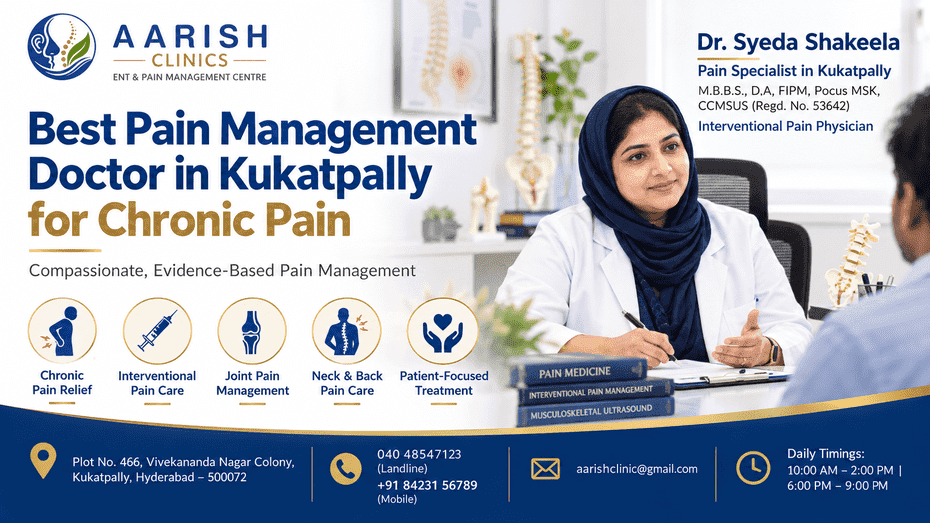
At Aarish Clinics in Kukatpally, chronic pain assessments and interventional procedures are directed by Dr. Syeda Shakeela, an experienced Interventional Pain Physician with over 14 years of clinical practice. Holding qualifications of M.B.B.S., D.A, FIPM, Pocus MSK, and CCMSUS (Regd. No. 53642), Dr. Shakeela specializes in non-surgical spine care, musculoskeletal ultrasound, and targeted interventional pain medicine.
Our Kukatpally clinic provides dedicated suites for high-resolution ultrasound examinations, outpatient day-care procedures, and patient education. The clinic is conveniently situated at Plot No. 466, Vivekananda Nagar Colony, Kukatpally, Hyderabad, easily accessible from KPHB Colony, Nizampet, Miyapur, Hitec City, and Bachupally.
Connect with our clinic online: Follow Aarish Clinics on Instagram for practical pain care awareness, posture tips, and clinic updates.
Frequently Asked Questions About Chronic Pain Care
Q1.Who should I consult for chronic pain in Kukatpally?
For persistent or complex pain lasting longer than 4 to 12 weeks, you should consult an interventional pain management physician. At Aarish Clinics in Kukatpally, Dr. Syeda Shakeela (Interventional Pain Physician with 14+ years of clinical experience) conducts detailed musculoskeletal and neurological evaluations to identify the specific anatomical pain generator and develop an individualized, non-surgical treatment plan.
Q2.What is the difference between a pain management doctor and an orthopaedic doctor?
An orthopaedic surgeon evaluates bone, joint, and spinal structures primarily to determine whether surgical repair, reconstruction, or joint replacement is necessary. In contrast, an interventional pain physician specializes in non-surgical and minimally invasive diagnostic and therapeutic procedures—such as ultrasound- and fluoroscopy-guided nerve blocks, epidural injections, radiofrequency ablation, and regenerative therapies—aimed at relieving pain and restoring function without open surgery.
Q3.Can chronic pain be treated without surgery?
Yes. A wide majority of chronic pain conditions—including back pain, sciatica, herniated discs, knee osteoarthritis, and cervical spondylosis—can be effectively managed without open surgery. Multimodal non-surgical approaches include structured physical therapy, ergonomic modifications, targeted medication adjustments, and precision image-guided interventions that directly address local inflammation and nerve compression.
Q4.Are nerve blocks effective for chronic pain?
Yes. Targeted nerve blocks can be highly effective both diagnostically and therapeutically. By delivering a local anesthetic with or without a targeted anti-inflammatory agent directly adjacent to the nerve transmitting pain signals, a nerve block can interrupt the pain pathway, relieve acute symptoms, confirm the exact anatomical source of pain, and provide a window of relief that facilitates physical rehabilitation.
Q5.Is radiofrequency ablation suitable for back pain?
Radiofrequency ablation (RFA) is a well-established, evidence-based procedure particularly suitable for chronic facet joint arthropathy in the lower back or neck, as well as chronic knee joint pain (genicular RFA). After a successful diagnostic medial branch block confirms that the facet joints are the pain generator, RFA uses thermal energy to temporarily desensitize the sensory nerves, providing pain relief that typically lasts from 6 to 18 months.
Q6.When should I seek medical attention for persistent pain?
You should seek specialist evaluation if your pain has persisted for more than 4 to 6 weeks, is worsening over time, disrupts your sleep, impairs your ability to walk or perform daily tasks, or does not respond to basic analgesics and rest. Immediate emergency care is required if pain is accompanied by red-flag symptoms such as sudden bladder/bowel incontinence, groin or saddle numbness, severe chest pain, or progressive limb weakness.
Q7.Where can I consult a chronic pain specialist in Kukatpally?
You can consult Dr. Syeda Shakeela at Aarish Clinics, located at Plot No. 466, Vivekananda Nagar Colony, Kukatpally, Hyderabad – 500072. The clinic is centrally situated and easily accessible from KPHB Colony, Nizampet, Miyapur, and Bachupally, offering dedicated consultation suites for interventional pain evaluation and image-guided musculoskeletal procedures.
Take the First Step Toward Long-Term Pain Relief
You do not have to live with persistent pain that restricts your mobility and lifestyle. Consult Dr. Syeda Shakeela at Aarish Clinics in Kukatpally for an accurate anatomical evaluation, scan review, and an individualized non-surgical treatment roadmap.
The clinical information provided in this publication is for educational and informational purposes only and is not intended as a substitute for professional medical advice, diagnosis, or individualized treatment. Chronic pain syndromes, recovery timelines, and procedure responses depend on individual diagnosis, overall health status, and clinical assessment. Always consult a qualified physician regarding any medical condition or pain symptom.
Selected Scientific References:
- Treede RD, et al. A classification of chronic pain for ICD-11. Pain 2015;156(6):1003-1007.
- Manchikanti L, et al. Comprehensive evidence-based guidelines for interventional techniques in the management of chronic spinal pain. Pain Physician 2013;16(2 Suppl):S1-64.
- Chou R, et al. Diagnosis and treatment of low back pain: a joint clinical practice guideline. Ann Intern Med 2007;147(7):478-491.